
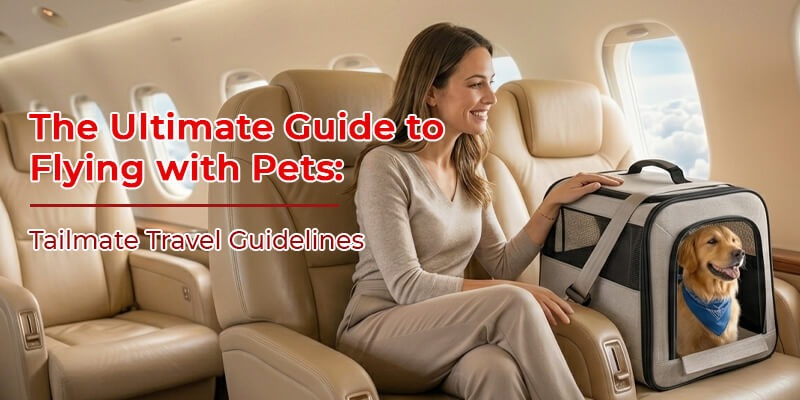
Traveling with a pet is never easy. New regulations, medical paperwork, and travel arrangements often need to be managed simultaneously. That’s why most pet parents find themselves asking one essential question: How can I prepare effectively for flying with pets?
Airlines often rely on their expertise in animal transport so that pet parents like you can enjoy a peaceful journey. In this article, we’ll help you adapt that knowledge to pet travel, covering procedures, regulations, and practical hacks. This way, you can ensure a safe and smooth journey for your four-legged companion, whether they’re flying in the cabin or the cargo hold.
What Requirements Do I Meet to Travel with Pets on a Plane?
The rules for traveling with dogs and other pet-friendly species are set by the airlines, the departure, and the destination countries. So, make sure you verify that you meet all the requirements for pet travel before proceeding with the flight booking process.
Some rules are common, while others vary by airline. For example, most airlines specify a minimum age requirement (12–15 weeks) for pets to travel. In addition, airlines usually require medical documents to confirm that pets are healthy and properly vaccinated.
Depending on the destination you are flying to, you may be required to obtain a veterinary health certificate and a pet passport, along with microchip identification. In addition, certain government regulations mark blood tests, quarantine periods, and parasite treatments as essential entry requirements.
The airlines offer recognized methods for traveling with a pet; you can either ship your tailmate as freight or carry it in the cabin as excess baggage. Each has its own conditions, which are outlined below.
Excess and checked baggage are the most common options offered by airlines for pet travel. This way, your pet may travel with you either in the cabin or in the hold, which is typically decided by the airlines after the pet's weight is measured. This facility is included in the ticket passengers purchase.
- Pet departures begin at the passenger terminal check-in counter.
- Airlines consider pet travel an add-on service, similar to extra luggage, offered with a flight ticket.
- Airlines charge passengers a fee for each item according to the following rate schedule.
Transport as air freight (cargo) is an independent service, which seems almost similar to the flight tickets booked exclusively for your pet.
- Pets do not depart from the passengers' terminal; they depart from the cargo terminal.
- Specific registration procedures include strict document verification, checking of transport crates, and mandatory customs declarations.
- Prices are actually calculated based on volumetric weight, not on the weight of the pets.
- Airlines charge higher freight rates due to sensitiveness of transport, which is comparatively expensive.
Can You Bring a Dog On a Plane? Airlines Rules for Pets on Board
Though airlines have announced pet travel policies allowing passengers to fly with their pets, do not misunderstand this as permission for all species. Airlines still impose restrictions on certain pet types for entry on board.
Most airlines allow pets to travel in the cabin as long as they meet the weight restrictions. They must fit in the Soft-Sided Pet Carrier, which weighs up to 8kg. It's your primary responsibility to ensure your furry friend's complete comfort in the pet carrier, allowing it to turn around, change posture (from lying down to standing), and settle with ease. This way, you can ensure a peaceful journey for yourself as well as for your four-legged buddy.
Always remember to settle your pet in the soft-sided carrier, which must not exceed or fall below the dimensions of 45 x 30 x 20 cm. However, you are advised to check each airline's policies to identify the exact carrier requirements for pet travel in the cabin.
Pet behavior is another important factor to consider when planning to travel with your furry friend. The animal must be calm and peaceful, and must avoid causing disturbance or posing a safety risk to fellow passengers.
Rabbits, ferrets, birds, or reptiles are some of the exotic pets that are commonly prohibited from traveling with their parents on most airlines.
You must always remember that the airlines criteria for prohibited pets in the cabin change, no matter how much they weigh or what their size is. Such cases are generally heard when they involve flights to Australia, the United Kingdom, or New Zealand.
What Special Rules and Restrictions Should I Know for Pet Travel?
Special exceptions and restrictions for Pet travel are also compiled by the airlines, along with the General rules you must know. These regulations are applicable to service animals, restricted breeds, and exotic pets.
Traveling with a Service Dog
Any dog employed for special purposes, such as guiding visually impaired travelers, alerting to medical emergencies, and providing emotional support, is generally categorized as a service dog. As per the airlines travel policy, such animals can travel in the cabin with their parent for free. Meanwhile, one must present documentation ( that may prove their dog is truly trained for such service and qualifies under the airlines’s service animal guidelines.
Depending on the circumstances, the airline may request a training certificate, medical note/doctor’s letter, behavior & health attestation, and vaccination/health records for service pets traveling in the cabin.
If you are one of the armed forces personnel and required to carry a service animal with you in the cabin, be careful to fill out the service animal forms in advance. This way, you can have a hassle-free boarding experience without facing last-minute denials or hurdles when seeking for travelling with pets on a plane.
Animals Under Prohibition or Restrictions
Airlines do not mean you can bring any breed on your trip in the cabin when hearing of the permission to fly with the dogs and cats on board. Some breeds are still not allowed to travel in the cabin, while others are permitted to travel but under certain conditions. We have categorised the prohibited or restricted breeds below in a listing pattern.
Brachycephalic Breeds
It refers to the pets, including cats and dogs, having short, broad heads and flat-faced, "pushed-in" noses. Cats such as Persian, Himalayan, Burmese, and Exotic Shorthair, and Dogs like Boston Terriers, Bulldogs (English, American, French), Shih Tzus, Pugs, and Boxers are allowed in the cabin as long as they meet the restrictions set by the airlines.
The conditions are:
- The pet must not exceed the size permitted by the airline’s cabin policy and should fit comfortably in the carrier, which should slide under the seat without hassle.
- The pet carrier must feature extra ventilation space.
- If you submit a veterinary clearance or a health certificate for your pet.
- You can take your pet on the trip if it's no longer than 4 hours. To learn about the specific restrictions on pet travel timing, always check the airline’s official site.
Wild or Exotic Animals
Monkeys, reptiles, ferrets, hedgehogs, and rodents are examples of Wild or Exotic Animals. If any of them belongs to you as your pet, then it may feel disappointing because most airlines strictly ban this type of animal in the cabin. These animals are neither transported nor allowed to travel as companions in the cabin.
Airlines do not allow farm animals, large animals, aggressive breeds (such as mastiffs, pit bulls (varies by airline), and chow chows), or venomous or dangerous species like snakes, spiders, or scorpions in any condition.
What Documentation Do I Need for Travelling with Pets?
To experience a seamless travel gateway with your pet, it is necessary that you have all the documents handy. And are required to submit in advance when appealing to travel with your furry friend. The documentation may vary by the country you plan to fly to, the animal type that’s one of your homies, and the airline you are scheduling your travel with. The documents you are supposed to submit are:
- Certificate of Veterinary Inspection
- Rabies Vaccination Certificate
- Microchip Registration Documentation
- Breed Verification Form
- Acclimation Certificate
- Airline-Specific Forms
- Medical Records Summary
At Air Transport Animal, you are provided with assistance through compiling the documents concisely to keep any issues away when checking in at the airport or arriving at the destination. For further guidance on traveling with a pet or requesting a quote, you can reach out to our team without any hesitation.
Which are the Airlines I May Expect to Travel with My Tailmate?
Before you book a flight, don’t get carried away just because airlines allow pets in the cabin. Always check whether your chosen airline truly permits pets. Otherwise, a mix‑up like this can ruin your mood and disrupt your travel plans at the last moment. To help you avoid such disappointments, we’ve outlined the airlines that allow unrestricted pet travel in the cabin.
Air France: It allows passengers to bring their beloved pet on board only if the animal weighs no more than 8 kg. If the pet exceeds the airline's size or weight limits for in‑flight travel, it must be transported in the cargo hold instead.
Lufthansa Airlines: You can take your pet on the Lufthansa flight as long as it is one of the domesticated animals, such as dogs or cats. And must not be weighing more than 8kg (17lbs).
KLM Airlines: Depending on the size and weight of your pet, their travel type may vary, such as cabin, cargo hold, or via freight
Quite the opposite, Ryanair, EasyJet, and WizzJet are some pet‑restrictive airlines that do not accept even household animals, neither in the cabin nor in the cargo hold.
Whenever planning to travel with your fur baby, make sure you prioritize checking the airline’s pet policy twice. For more clarity on pet travel, have a conversation directly with the professional pet transportation service to ensure you have all requirements handy to avoid last‑minute surprises.
How Can I Secure Flight Tickets for My Pet?
Generally, the booking procedure is determined after the method you choose to transport your pet.
You can book tickets for your pet along with your flight reservations or manage bookings when they are intended to travel as excess baggage. In this case, it is treated as an additional service attached to the passenger's booking.
If your pet is being transported by freight, you cannot book directly through the airline’s portal; instead, the reservation must be made through a freight forwarder or a professional pet travel service.
How Much are the Fees for Pet Air Travel?
Airlines often offer three main options for pet travel: in‑cabin, as checked baggage, or in the cargo hold. The choice depends primarily on your pet’s size and weight, and fees vary by option.
- In-cabin Pet Travel: from €30 to €125 per flight.
- In the cargo hold: from €75 to €300.
- By air freight (cargo): starts at €500.
Extra charges may consist of:
- Booking or renting an IATA-approved travel crate (starting from €40 to over €200)
- Charges related to Pet vaccinations and health certificates
- The cost for Customs or import varies by destination
- Operational support and smooth handling, if needed
Suggested Guideline to Effectively Prepare a Pet for In-Cabin Travel
If you want your pet not to become violent when seeing a new face on the plane, make sure you follow the essential tips discussed below. By doing so, you can enjoy a peaceful journey while your pet remains calm, comfortable, and well‑adjusted throughout the flight.
- Familiarize your fur baby with the crate you are planning to carry them in. You should start this practice days or weeks before the expected departure date. To properly familiarise them with the carrier, keep it open at home, place toys or a blanket inside it, and encourage your four-legged buddy to willingly enter it.
- On the day of travel, make sure your fur baby gets some exercise and is fed at least four hours before the flight. Feeding them beyond this timeframe can lead to nausea and discomfort during the journey.
- Place a label on the crate clearly displaying your furry friend’s name, contact details, and flight information. Doing this is not obligatory but helps with the crate’s easy and quick identification, safe handling, and tracking in case of delays, rerouting, or any unexpected issues during the journey.
- You should avoid giving sedatives to your pet unless recommended by a veterinarian, as they may cause difficulty in breathing or even suffocation during the flight.
- Equip the crate with absorbent padding, add a cute toy, and include a piece of your clothing that carries your scent. This simple setup is highly effective in keeping your pet calm and feeling safe throughout the journey.
By organising everything beforehand, your flying with pets becomes smoother and more peaceful for both of you. Air Transport Animal is here to support you at every step.
FAQs
Q: Which airlines allow pets on the plane?
A: Lufthansa Airlines, KLM Airlines, Air France, Delta Airlines, United Airlines, Turkish Airlines, and Singapore Airlines allow pets on the plane.
Q: How much do airlines charge for pets in India?
A: Airlines accepting pets on board typically charge from ₹3,000 to ₹9,000. Though the charges vary by route, airline brand, and pet size.
Q: Are there weight or size limits for my pet?
A: Whether you are flying domestically or internationally, every airline has a distinctive pet policy that varies based on the size and weight of your pet.
Q: Can I buy my pet a seat on a plane?
A: Unfortunately, airlines do not have a policy that allows booking a standard seat for pets in the same way as for passengers.


